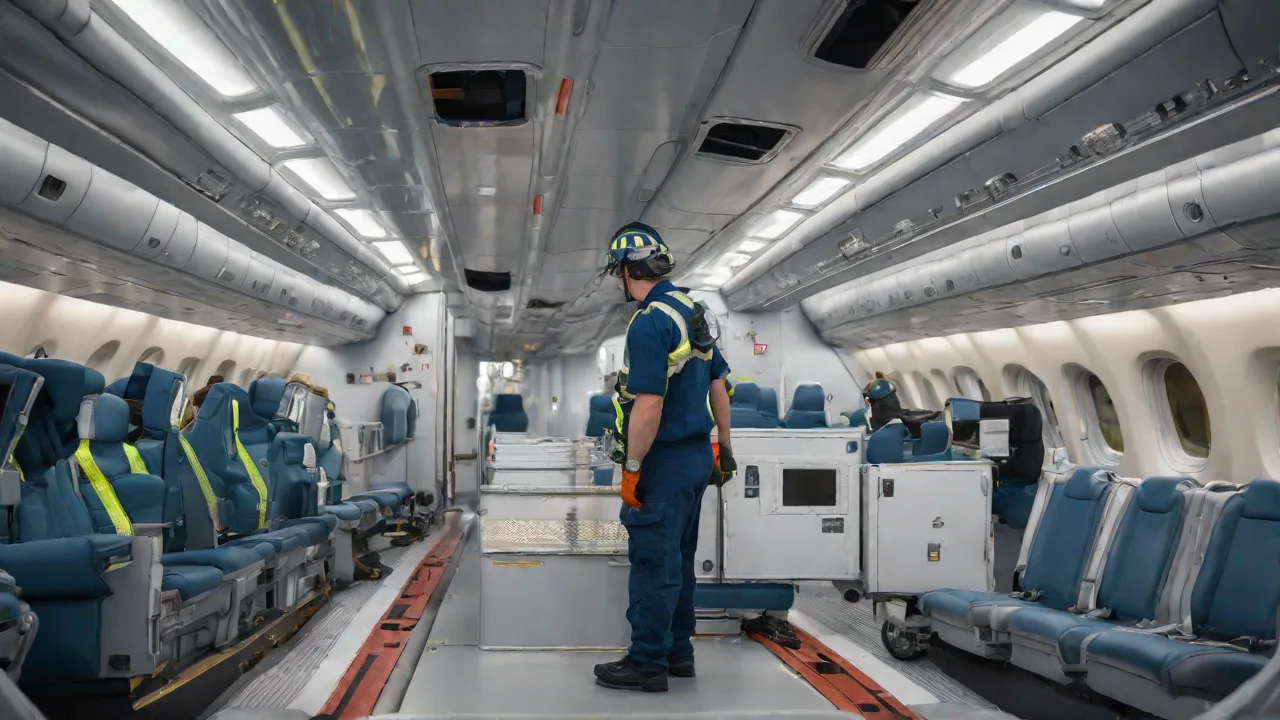
Ar Simulation for Emergency Response Drills in Aviation Industries
Augmented Reality (AR) simulation is rapidly reshaping how the aviation industry prepares its workforce for high-stakes emergencies. By merging digital overlays with real-world environments, AR creates immersive training scenarios that are both safer and more effective than traditional drills. As airlines and airports face increasing pressure to improve response times and reduce human error, AR offers a scalable, repeatable, and cost-efficient solution. This article explores the technology behind AR simulation, its benefits, implementation strategies, real-world case studies, technical hurdles, and the road ahead for emergency response training in aviation.
What Is AR Simulation for Emergency Response?
AR simulation for emergency response is a training method that overlays computer-generated imagery—such as smoke, flames, debris, virtual passengers, or system alerts—onto the real physical environment. Trainees wear AR headsets (e.g., Microsoft HoloLens, Magic Leap) or use tablets/smartphones to see these digital elements integrated with actual equipment, vehicles, or buildings. Unlike virtual reality (VR), which immerses the user in a fully synthetic world, AR keeps the user grounded in reality, making it ideal for practicing procedures that require physical interaction with real objects (e.g., fire extinguishers, aircraft doors, evacuation slides).
In aviation, AR drills can replicate nearly any emergency scenario: aircraft engine fires, cabin smoke, runway incursions, hazardous material spills, medical emergencies, or terrorist threats. The key advantage is that trainees practice in the same physical space they would occupy during a real event—a hangar, tarmac, or terminal—while the AR system adds dynamic challenges that evolve based on the trainee’s actions.
Key Benefits of AR in Aviation Emergency Drills
AR brings several distinct advantages over traditional training methods, which often rely on static mock-ups, tabletop exercises, or costly full-scale live drills.
- Unmatched Realism Without Physical Risk: AR environments simulate smoke, fire, structural damage, and panicked crowds with high fidelity. Trainees can practice moving through "virtual flames" or navigating collapsed aisles without any danger. This realism triggers genuine stress responses, improving decision-making under pressure.
- Cost and Resource Efficiency: Building physical mock-ups for every possible emergency is prohibitively expensive. AR eliminates the need for specialized props (e.g., a fake fuselage section dedicated to fire drills) and reduces wear on aircraft used for training. A single AR system can run hundreds of different scenarios, from a medical incident in the cabin to a triple-engine failure.
- Repeatability and Standardization: AR sessions can be recorded, replayed, and analyzed. Trainers can run the same scenario for every team member under identical conditions, ensuring consistent assessment. Trainees can repeat difficult sequences as many times as needed without requiring additional logistical setup.
- Immediate, Data-Driven Feedback: Modern AR systems track eye movement, hand gestures, and navigation paths. After a drill, the system can generate a report showing exactly where the responder hesitated, which steps were missed, or how quickly they reached a critical point. This objective data helps identify skill gaps far more accurately than subjective observation.
- Safe Exposure to Rare, High-Severity Events: Many aviation emergencies (e.g., tail-strike fire, bird-strike after takeoff, rapid decompression) are too dangerous to practice with real aircraft. AR allows crews to experience these rare events repeatedly, building muscle memory and procedural fluency in a zero-risk environment.
Implementation Strategies for AR Training in Aviation
Successfully deploying AR simulation for emergency response requires careful planning around hardware, content creation, and integration with existing curricula. Airlines and airports typically follow these steps:
Hardware Selection
Most aviation AR training uses either head-mounted displays (HMDs) for hands-free operation or handheld devices for lower-cost deployments. HMDs allow responders to use both hands to manipulate equipment and carry out physical tasks. Tablets are often used in group instruction where trainees observe a shared feed. Commercial solutions like the Microsoft HoloLens 2 and RealWear Navigator are popular choices because of their ruggedness, field of view, and spatial mapping capabilities.
Scenario Authoring and Customization
Creating realistic AR scenarios requires 3D modeling of aircraft interiors, airport layouts, and emergency props. Many aviation trainers partner with specialized developers—such as Taqtile or Inglobe Technologies—who build custom libraries of virtual hazards, animated passengers, and event triggers. Scenarios can be made adaptive: for instance, if a trainee fails to close a fuel valve, the virtual fire may intensify.
Integration with Existing Training Programs
AR does not replace classroom instruction or live drills—it complements them. Most aviation authorities (e.g., FAA, EASA) require a blend of theoretical knowledge, practical exercises, and periodic recertification. AR fits into the practical slot, often used between initial ground school and periodic live-drill assessments. Airlines such as Delta, Lufthansa, and Emirates have piloted AR modules as part of their recurrent emergency training, while airport fire services (ARFF) use AR to practice vehicle positioning and agent application.
Real-World Case Studies
Case Study 1: Major International Airport – Aircraft Fire Simulation
At a large European hub, the fire rescue team integrated AR into their quarterly exercises. Instead of burning a real jet fuel spill, they used an AR overlay that showed a virtual fire spreading from an engine. Responders donned gear, approached with hoses, and "extinguished" the virtual flames by aiming at digital hot spots. The system tracked water stream accuracy and timing. The result was a 30% reduction in average extinguishing time over six months, and a measurable improvement in crew coordination.
Case Study 2: Airline Cabin Crew – Emergency Evacuation Drills
A major U.S. carrier deployed AR headsets in its training center to simulate cabin smoke and blocked exits. The AR system generated realistic smoke particles that shifted with head movement, and audio cues (alarms, passenger shouts). Crew practiced brace positions, door opening sequences, and crowd control. Feedback showed that confidence in handling real evacuation improved by 40%, and trainees reported that the AR experience felt "more real" than the static mock-up drill.
Case Study 3: Maintenance Emergency Simulation
AR is also used to train ground crew in non-passenger emergencies, such as fuel spills or hydraulic leaks. A regional airline used AR overlays on actual maintenance hangars to teach safe containment procedures. The system highlighted hazard zones, showed virtual leak sources, and provided step-by-step cleanup instructions. This reduced cleanup practice time by half while improving procedural compliance.
Technical Considerations and Limitations
While AR simulation offers powerful benefits, it is not without challenges. Aviation trainers need to be aware of the following technical and operational constraints:
- Tracking and Registration Accuracy: For AR to be effective, virtual objects must stay anchored precisely to real-world locations. Motion tracking errors can cause "drift," making a virtual fire appear to slide across the floor. High-end HMDs with spatial anchors and sensor fusion (IMU + cameras + LiDAR) mitigate this, but budget solutions may struggle.
- Fidelity and Graphics Realism: Low-resolution textures or unrealistic animations can break immersion. Creating photorealistic 3D environments requires investment in modeling and rendering. However, with engines like Unity and Unreal, even smaller training budgets can achieve convincing visuals.
- Liability and Certification: Aviation regulatory bodies have not yet fully defined standards for AR-based training hours. Some authorities require documented evidence that AR drills meet the same learning objectives as physical drills. This is evolving; the FAA has published advisory circulars encouraging simulation where it meets equivalent performance criteria.
- Hardware Wear and Battery Life: AR headsets used in physically demanding drills (climbing stairs, crawling, wearing fire gear) must be rugged and sweat-resistant. Battery life typically ranges from 2–4 hours, which may limit extended training sessions.
- User Comfort and Motion Sickness: Although AR causes less nausea than VR because the real world is visible, some users still experience discomfort when moving and seeing digital objects at fixed positions. Proper calibration and short sessions can minimize this.
Future Directions for AR in Aviation Emergency Training
The next decade will see significant advances in AR simulation that will transform aviation emergency drills even further.
AI-Driven Adaptive Scenarios
Artificial intelligence can create branching storylines that react to trainee decisions in real time. For example, if a responder chooses the wrong type of extinguisher, the virtual fire could flashover, forcing them to retreat. Such adaptive training forces critical thinking and prevents rote memorization of fixed sequences.
Haptic Feedback and Physical Props
Gloves with haptic actuators can simulate the vibration of an emergency slide deploying or the heat of a door handle. Combined with physical props (e.g., a real extinguisher instrumented with sensors), AR can provide a convincing tactile layer that enhances muscle memory.
Multi-User Collaboration and Remote Training
AR allows geographically dispersed teams to train together in the same virtual space. An air traffic controller in one location, a firefighter on the tarmac in another, and a cabin crew supervisor in a third can all see the same AR overlay and communicate through spatial audio. This is especially valuable for coordination drills that involve multiple agencies (airline, airport, local emergency services).
Integration with Digital Twins
Airports are building digital twins—real-time 3D replicas of their entire facility. AR training can tap into these twins to pull live data (e.g., current occupancy, gate status, weather) and create hyper-realistic scenarios based on the actual airport configuration. This level of fidelity prepares responders for the specific layout they will face during an emergency.
For a deeper look at how AR is evolving in industrial training, the Aviation Today website frequently covers new simulation breakthroughs. Additionally, the FAA's training and simulation resources offer regulatory insights. Research from organizations like the National Academies of Sciences, Engineering, and Medicine also explores the effectiveness of AR for emergency response.
Conclusion
AR simulation is not a futuristic gimmick—it is a proven, practical tool that is already improving emergency response training in aviation. By delivering realistic, safe, repeatable, and feedback-rich scenarios, AR helps responders build the skills and confidence needed to act decisively when lives are on the line. Airlines, airports, and regulatory bodies that invest in this technology today will be better prepared for the emergencies of tomorrow. As hardware becomes lighter, software more intelligent, and content libraries more comprehensive, AR will almost certainly become a standard component of every aviation emergency training curriculum. The message is clear: the days of relying solely on static props and drills are numbered. Augmented reality is here, and it is making aviation safer, one simulated drill at a time.